
Why do the tabled values for Hilti Hit HY 200-R V3 anchors report higher values for C2 anchors than calculated within the Hilti PROFIS software.
For instance - A C2 grade 8.8 M24 anchor is shown to have 82kN capacity within the technical brochure versus 44.88kN calculated within PROFIS.
Note the capacity of grade 8.8 M24 bolt to NZ3404 is 133kN - would using Hilti data for concrete breakout, pryout strength etc but using NZS 3404 to calculate the steel strength be an acceptable approach.
Hi Andrew,
The table value of ~82 kN reflects the ideal ETA conditions for an M24 HAS‑U 8.8 anchor in Seismic C2: no edge influence, α_gap = 1.0 (annular gap closed) and no lever arm. Under these assumptions, the anchor behaves as a pure shank-in-shear element and achieves the highest steel shear resistance.
In Profis Engineering, the default Seismic C2 model is more realistic:
• The annular gap is open, so α_gap = 0.5, immediately halving steel shear capacity.
• Any plate/grout stand‑off introduces a lever arm, which triggers EN 1992‑4’s “steel failure with lever arm” check, further reducing V_Rd,s.
Additionally, EN 1992‑4 does not use the full M24 shank area for shear, because a bonded threaded rod resists shear at the threaded section, not at the smooth shank diameter. The code therefore uses the stress area based on the thread pitch diameter, which is significantly smaller and further reduces the calculated steel shear resistance compared with an expansion anchor shank.
Combining these effects (α_gap = 0.5, lever arm, and thread‑root shear area), Profis correctly reports a design capacity around ~ 45 to 50 kN.
NZS 3404 bolt shear values cannot be used for post‑installed anchors; NZS 3101 requires ETA‑based design using EN 1992‑4/TR 045, which includes all of the above seismic and threaded‑rod adjustments.
We are happy to provide more information or code excerpts where these parameters are defined, please let us know.
If you have any questions, we are here to support you.
Thanks for replying Suman,
I have selected annual gap is filled so the gap factor is 1.0 and there is not grout/plate stand off.
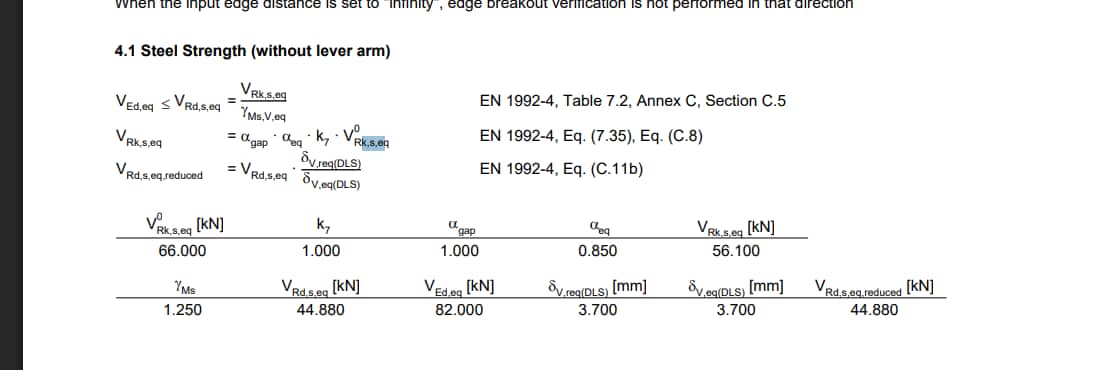
The only reductions are the Alpha(eq) value of 0.85 and material factor of 1.25 which is applied to the V0Rk,s,eq value of 66kN. i.e 0.85x66kN/1.25 =44.88kN.
Refer attached image - my question is if the value of V0Rk,s,eq = 66kN is correct, how can the value of 82kN within the Hilti brouchue be correct?
Also note that the value of 133kN from 3404 is the for threads included within shear plane.
Please call me on +64 4 473 8361
Hi Andrew,
In response to your query regarding seismic performance of anchor under shear loading, I would highlight that there's a performance difference between HAS 8.8 and HAS 8.8 HDG anchors, the value 66KN is applicable to HAS 8.8 HDG anchors while HAS 8.8 have a characteristic resistance of 103 KN.
Now, there's a misprint in the technical brochure where the table refers to 82.4 KN as the characteristic resistance of HAS 8.8 which is not the case. The table indicates the design resistance values, and it has been mislabeled.
As for the 133KN resistance as per NZ3404, the code refers to structural steel bolts, whereas we have to follow post installed anchors design code NZ3101. Please understand that the performance of the anchors varies depending upon it's application type.