
Firestop and risk management in data centres
Despite the well-known threat that airborne contaminants pose to IT equipment, many data centres unwittingly design risk into their facilities by selecting traditional firestopping materials such as coated firestop batts. When these are repenetrated to accommodate frequent cabling changes, it releases high concentrations of particulate matter into the airflow. To help prevent failures due to airborne contamination, it’s important to specify fibre-free firestopping products.
Particulates endanger reliability and energy efficiency
As modern IT equipment gets smaller and smaller, it improves efficiency but also increases its susceptibility to problems associated with airborne contaminants in the data centre environment.
According to ISO 14644-1 – the international standard for classifying the cleanliness of the air in cleanrooms and clean zones – most design guidelines recommend that data centres are classified and operated as clean room class 8 environments. Furthermore:
“Particulate contamination can increase a data centres’ power demand by 2% or more.” [1]
While achieving a 100% particle-free environment is neither feasible nor necessary, adhering to recommended contamination limits helps to protect sensitive IT equipment. Unfortunately, frequently used traditional firestopping products introduce a source of contaminants that may compromise data centre operations, leading to energy waste and even to unplanned downtime.
Cabling changes: a potential source of contamination
Where services such as pipes or cables penetrate through partition walls, firestopping products aim to re-establish the integrity of the wall. In many parts of the world, low-cost firestop mineral wool boards (commonly known as “firestop batt”) are the most widespread method of firestopping such penetrations.
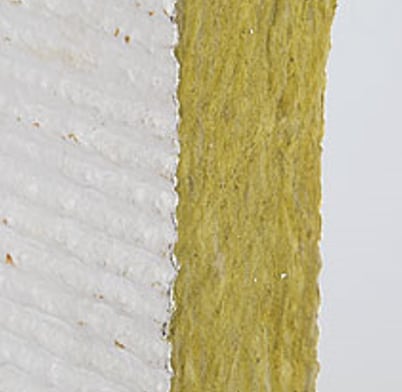
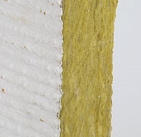
Coated firestop mineral wool board [2]
Firestop batt is made of fibres made from metallic ore and igneous rock and is effective at reducing the transmission of heat, flames, toxic smoke and other gases. Although generally perceived to be harmless because a coated layer encloses the fibres once initial installation is complete, the boards are a source of significant particle emissions in many data centres.
Measuring particulate release during firestop board re-penetration
The Fraunhofer IPA Institute (Stuttgart) – specialists in clean room environments – assessed particle concentrations that are released when repenetrating traditional firestop systems.
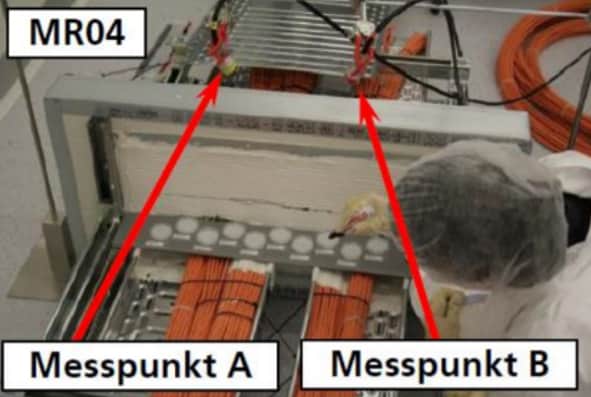
Measurement of particulate release during firestop board re-penetration [3]
Fraunhofer concluded: “The re-penetration of firestop mineral wool coated board as shown in this test series (adding or changing installed cable trays and/or cable bundles) should be avoided in cleanrooms of any ISO Class acc. ISO 14644-1 due to the high airborne and sedimenting particle emission levels caused by the re-penetration activities.” [3]
Fibre-free products reduce the risk of airborne contamination
As you can see, it is crucial to choose products that not only enable cleanliness at initial construction, but also with each subsequent cabling change. You can help to eliminate future contamination sources at the design phase by selecting fibre-free firestopping materials designed to meet the needs of dynamic cabling environments.
For example, firestop pathway devices such as the Hilti Firestop Sleeve not only reduce the risk of airborne contamination, but also reduce the amount of costly, cooled air escaping the data halls.
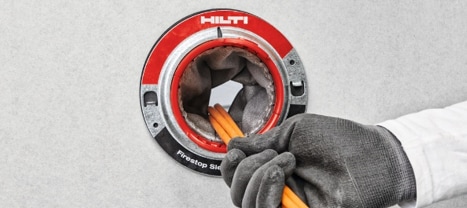
Firestop Sleeve cable penetrating
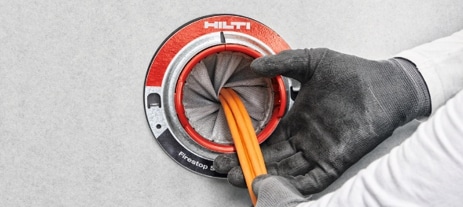
Firestop sleeve closing
For larger openings to accommodate multiple services such as cable trays, or ducts, you could consider reusable fibre-free products such as Hilti Firestop Blocks.
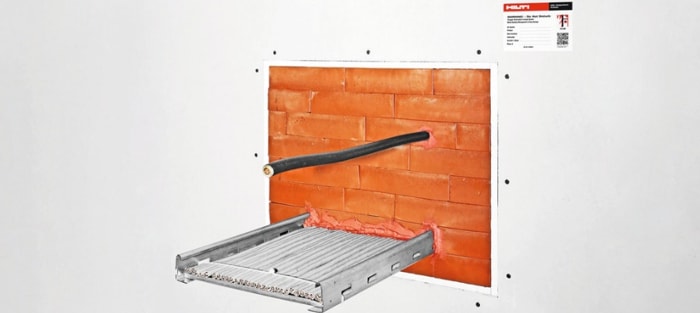
The Fraunhofer Institute also tested the Hilti Firestop Block and assessed its particle emission behaviour, concluding it is suitable for cleanroom applications from “class 4” to “class 9” (ISO 14644-1). [4]
Fibre-free products not only reduce the release airborne contaminants during cabling maintenance, but they also reduce total facility cost, in addition, they help enhance security by reducing the need for specialized maintenance personnel during cabling changes.
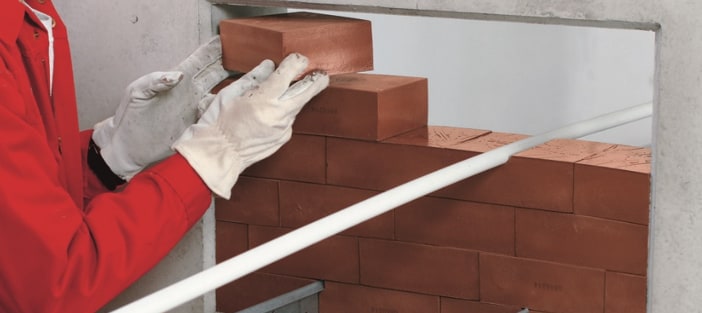
From a long-term perspective, the use of cleaner technologies designed for re-penetration not only helps to ensure a longer equipment lifespan and higher energy efficiency, but it also reduces maintenance efforts while keeping the data centre flexible for future growth.
References
[1] The Threat of Data Centre Contamination – by Colleen Miller on 14.09.2010. Available at: http://www.datacenterknowledge.com/archives/2010/09/14/the-threat-of-data-centre-contamination/ [2] Design Considerations for Datacom Equipment Centers – Second Edition – ASHRAE Datacom Series 3 – ASHRAE
[2] Ablative coated batt. Available at: http://www.insulationexpress.co.uk/Insulation/Rockwool-Ablative-Coated-Batt.htm
[3] Machbarkeitsstudie zum partikulären Emissionsverhalten bei einer Kabelnachbelegung – Fraunhofer IPA report HI 1702- 888-3 from 24.05.2017
[4] Hilti Firestop Block CFS-BL: Cleanliness suitability and cleanroom suitability tests at Fraunhofer IPA – report HI 1702-888-2 from 05.05.2017