
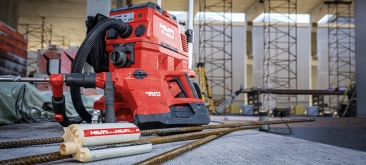
Concrete-to-concrete connections under fire load according to EN 1992-1-2 using Hilti HIT-FP 700-R cementitious injection system
After years of research, Hilti unveils the "Hilti HIT-FP700 R injection system," a two-component inorganic mortar system for post-installed rebar connections. It is the first to meet ETA 21-0624 under EAD 330087-02, featuring enhanced fire resistance. Unlike traditional systems that fail at temperatures much lower than 500°C, HIT-FP 700 R maintains at least 2.3 N/mm² bond strength under fire conditions.

Figure 1: Hilti HIT-FP 700 R injection system - foil pack
1. POST-INSTALLED REBAR APPLICATION ACCORDING TO EAD 330087
Since the 1970s, adhesive anchors have been vital in construction, particularly for concrete-to-concrete connections using chemical mortar. Post-installed reinforcement involves placing deformed bars in drilled concrete holes filled with injectable mortars, securing new concrete to existing concrete. Performance hinges on the mortar's robustness under various conditions and proper installation. Currently, mortar systems for these connections are evaluated by EOTA's EAD 330087-02 for static, seismic, and fire conditions and EAD 332402-00-0601 for bond-splitting behavior.

Figure 2: Overview of European regulatory framework for post-installed applications
Hilti offers products like HIT-RE500 V4 and HIT-HY 200-R V3, and now introduces the HIT-FP700 R inorganic mortar for these connections. The article explores post-installed rebar connections per EN 1992-1-1, emphasizing fire design.

1.1 Why is fire design so important?
Fire risks in construction demand preventive measures to safeguard lives, health, and the environment. Buildings should have fire-resistant sections. Post-installed rebar connections in fire-rated assemblies need evaluated fire resistance, designed for specific periods (30-240 minutes). Connections are categorized into overlapping splices and intersections with varying fire exposure. The next chapter discusses HIT-FP 700 R's fire performance assessment.

2. FIRE PERFORMANCE
2.1 Fire qualification
The European Assessment Document EAD 330087-02 covers fire qualification for post-installed rebar connections, focusing on mortar bond strength behavior with temperature. Tests simulate fire conditions, applying constant load while heating the specimen. The temperature reduction factor kfi (θ) helps calculate bond strength under fire. Cement-based mortars, like HIT-FP 700 R, show lower fire sensitivity than resin-based systems.

Figure 9. Example of the graph of resin-based reduction factor kfi (θ) for concrete strength class C20/25, from EAD 330087-02
2.2 Fire design of post-installed rebar
Design follows Eurocode 2, using assessed mortar performance characteristics. The design includes verification for static and fire conditions. The European Technical Assessment provides bond stress values related to temperature, calculated using reduction factors and temperature profiles from EN 1992-1-2. The Resistance Integration Method calculates overall bond stress by subdividing the embedment length into segments, each with specific temperatures and bond contributions.

Figure 10. Example of temperature profiles for slabs with height h = 200 mm, from EN 1992-1-2, annex A, figure A.2
2.3 Performance of HIT-FP 700 R
HIT-FP 700 R withstands high temperatures, maintaining bond strength under fire. It surpasses organic materials and concrete compressive capacity under fire conditions. For concrete class C20/25, HIT-FP 700 R retains 2.3 N/mm² bond strength at 504°C.

Figure 11. Graph of reduction factor kfi (θ) and design bond strength in fire conditions of HIT-FP 700 R for concrete strength class C20/25, compared to epoxy system and concrete
2.4 Performance comparison for cold and fire design
HIT-FP 700 R excels in overlapping splices (e.g., slab-to-slab connections) with the shortest embedment length required under fire conditions. For intersections (e.g., slab-to-wall connections), it shows less differentiation but still performs well in four-sided fire scenarios like beam-to-column connections.
Interested in more technical information about HIT-FP 700 R? Go to part 2 of this article through this link.
The information provided in this article is for general information purposes only. While we strive to ensure the accuracy and reliability of the information presented, it is not intended as legal, technical or professional advice. Hilti makes no representations or warranties of any kind, express or implied, about the completeness, accuracy, reliability, or suitability, with respect to this article for any purpose.